In the last post, I talked about structuring the opening game for when your commander comes into play. In that conversation, I had mentioned mana curve, which is a visual graph of all of your spells’ mana values. It is a great way to see how cost-effective your deck is. Now the shape of this curve is like a bell, the peak of the curve representing the largest amount of spells with that mana cost. The beginning of the curve is cheaper spells, usually around 1 and 2 converted mana cost (CMC). Typically, the center of the curve can be 3-4 CMC, and we will then pinch off around the 5+ side of mana costs. It is important to try and understand what your current curve looks like so you can adjust it to fit your game plan.
For this blog post, I will be talking about my favorite commander, who is due for a bit of an upgrade. Let’s take a look at my commander’s current mana curve and see what I plan to do to tweak it for my upcoming matches. It is one of my most played commanders, and it would be a disservice to say that it isn’t one of my favorite decks I own.
K’rrik Son of Yawgmoth
K’rrik Son of Yawgmoth is a mono black commander with a great set of abilities that allow me to make very explosive plays as soon as he enters the battlefield. His best quality is his ability to make anything with a black mana pib turn into phyrexian mana, which is mana that can be paid for with 2 life. This gives way to very fast ramping and fast plays. K’rrik himself costs 4 generic and 3 black phyrexian mana, which makes his converted costs either 7 mana or just 4 mana and 6 life. It’s no secret that most players say that you want to have K’rrik out as soon as possible so you can generate all the value that comes from playing more black spells. The reason for that is his second ability, which pairs really well with his lifelink effect. Whenever a black spell is played, our commander gets a +1/+1 counter added to him. This can easily make up for all of the life lost while casting all of our spells.

Putting commander CMC to the curve
However, besides that, we need to think about this in relation to making ourselves a curve that plays really well with the game plan we have in mind. There are some questions we should ask ourselves that could impact how we structure the deck.
For starters, when are we planning to play our commander during the game? I think it’s important to think about when we want to see our commander in play. It is the card we love the most, and it’s one of the most important pieces to deck building in the format. I, for one, love fast pace, aggressive magic, so my goal is to get him out as soon as possible so I can start paying some life to play good spells that will help me win the game. Now I can be vanilla and just wait to get the mana to pay the seven, but I would rather use six of my life and pay for four. So, with that established, I would set my commander in the 4 range of the curve; this will be my baseline for how I organize my spells. They will revolve around the idea that my commander will come out in turn four or three.
In order to really build a good board state, that could mean that I have plenty of life to spend, or I have plenty of cards in hand to use my life for in the future with K’rrik. I need to be active and engaged in the game and play spells that keep me alive till I get my commander out. Which we have established can happen on either turn 3 or 4. This is assuming I am adding good ramp or mana rocks into the deck. The best way to achieve this is to make sure that a majority of my cards fall within the range of 1 through 4. I expect the curve to be able to peak just around the 3-4 range. I want to have either some spells in the beginning that can ramp me up, or some cheap creature spells to play early on to be able to get me some life, like perhaps creatures with lifelink or some sort of drain effect. As much as I want big costing cards that do crazy stuff in the game, if a majority of my deck is that, there is a good chance I won’t be alive long enough to be able to play them. I can have those kinds of cards; it’s important to have an endgame in mind. But the chances of me playing those spells all the time are very low. I’d rather be involved and participating all throughout the game than just sit there with the big spells and maybe play the flashy stuff turn five or six.
I have been playing around with this curve here and there, and this was what I had at the start of this post.
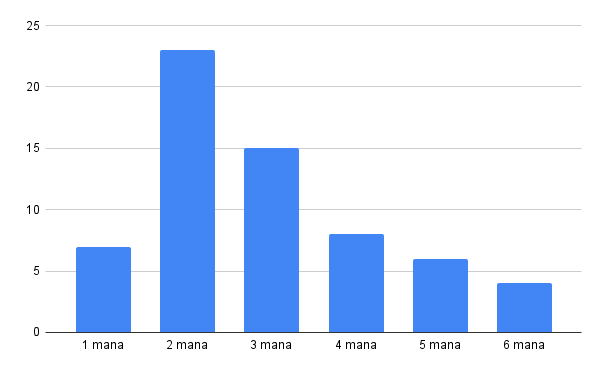
The peak of this is at 2. I really want to adjust the curve and maybe distribute evenly across. A little more 1 costing card, and maybe I can be more thoughtful about the more costly cards. I think the spells that I want that I need to be cheap, like removal and ramp spells, should fall on the cheaper spectrum of cost. I have a lot of expensive creatures that act as removal or card draw. But, not enough cards that help me win the game. So I will be playing around with that soon, and I will be posting my first game with K’rrik pretty soon.

 THEMTGCOWBOY